

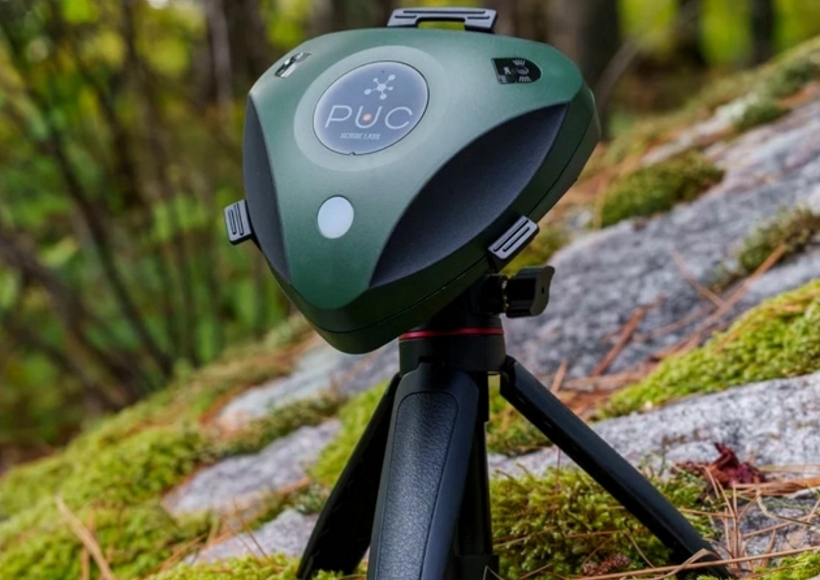
The BirdWeather PUC (Portable Universe Codec) is a compact device for automated acoustic environmental monitoring. It records natural sounds using two microphones, while artificial intelligence helps identify birds by their calls. The device is designed for both backyard observation and field use.
How BirdWeather PUC works
The device is based on an acoustic monitoring system featuring two microphones, Wi-Fi and Bluetooth Low Energy (BLE) wireless interfaces, GPS, environmental sensors, and an integrated neural processor.
The PUC can continuously monitor the environment and record soundscapes. When connected to a home Wi-Fi network, the device transmits data to the BirdWeather cloud platform, where it is automatically processed.
The BirdNET neural network is used for sound recognition. It is a joint project of the K. Lisa Yang Center for Conservation Bioacoustics at Cornell University and Chemnitz University of Technology.
According to the manufacturer, the system is capable of recognizing over 6,000 bird species worldwide. In addition to birds, it identifies other sound sources, including coyotes, dogs, squirrels, frogs, and insects. The system also recognizes man-made sounds, such as those from engines and fireworks.
Birdwatching near home
One use case for the BirdWeather PUC is continuous bird monitoring in a garden or near the home.
Simply connect the device to your home Wi-Fi network and place it in a suitable location. The station will record ambient sounds and transmit the data for automatic analysis.
The BirdWeather mobile app for iOS and Android is available for viewing results. It allows you to listen to soundscapes and share observations with other community members.

Use in travel and field research
The BirdWeather PUC is designed for more than just stationary installation. A built-in microSD card allows the device to be used away from your home network.
You can take it along on walks, hikes, and trips. The recorded data is subsequently uploaded to the BirdWeather cloud platform, where it is processed and made available for study.
The manufacturer also envisions the use of the PUC for long-term monitoring of natural areas. To this end, various power supply options are available, along with the capability to record data to a memory card or transmit it via a mobile hotspot.
Additional environmental sensors
In addition to acoustic components, the BirdWeather PUC is equipped with sensors for measuring environmental parameters.
The device tracks:
– temperature;
– relative humidity;
– atmospheric pressure;
– air quality;
– the total concentration of volatile organic compounds (tVOC);
– carbon dioxide (CO₂) concentration;
– spectral characteristics of the lighting.
Thus, the system collects not only acoustic data but also information about environmental conditions.
BirdWeather cloud platform and community
Recordings captured by the PUC are automatically processed by the BirdWeather cloud system. Users can view observation results, explore soundscapes, and share data to participate in a collaborative bird monitoring project.
BirdWeather also provides data access tools via a GraphQL API, a REST API, and its own Data Explorer .
A distinctive feature of the platform is a global observation map that aggregates data from the community’s acoustic stations.
Cost and availability
On the official BirdWeather store page, the standard PUC model is listed at $299 USD. Shipping costs and terms may vary by region.
The BirdWeather PUC combines an autonomous audio recorder, a neural network-based sound recognition system, and an environmental monitoring station. The device enables automated monitoring of birds and other natural sounds without the need for constant human presence near the equipment.