

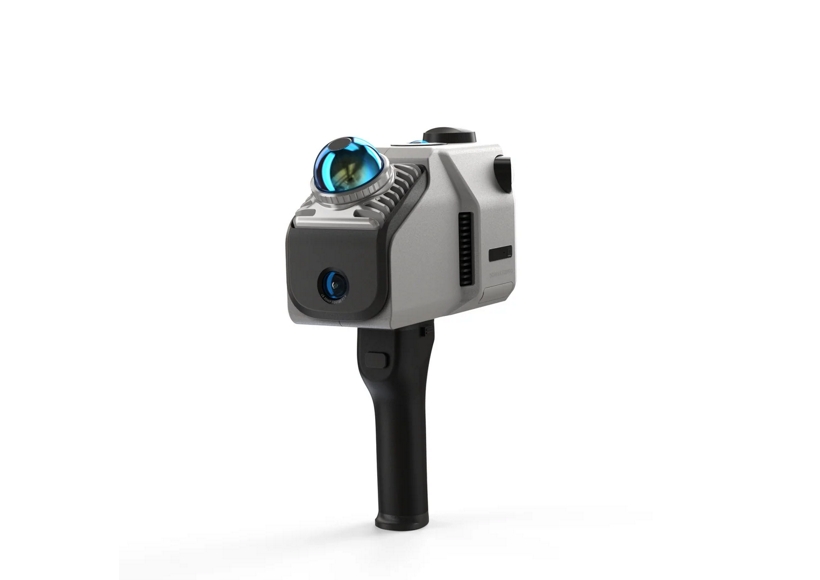
Eagle is a handheld spatial 3D scanner from 3DMakerpro. The device is designed to digitize large objects and entire spaces, such as buildings, interiors, streets, construction sites, and landscapes.
Unlike compact 3D scanners designed for small objects, Eagle utilizes LiDAR technology and the SLAM spatial positioning system. The scanner collects data on surrounding surfaces to generate a 3D point cloud, while cameras add color information and photographs.
The model was unveiled in February 2025 and is primarily aimed at professional use in architecture, construction, surveying, and the creation of digital twins and virtual spaces.
How a scanner works
Eagle uses a 905 nm LiDAR laser rangefinder. It measures the distance to objects and collects up to 200,000 points per second. A SLAM system helps determine the device’s position while in motion and integrates the collected measurements into a unified spatial model.
The scanner supports a 360° horizontal and 59° vertical field of view . This enables data collection from the surrounding environment without the need to repeatedly change the device’s orientation.
The manufacturer specifies a scanning range of 80–140 meters. The scanning radius is 40–70 meters and depends on the surface reflectivity.
Cameras and the creation of realistic 3D models
The Eagle is available in two versions:
– Standard — a single 48 MP camera.
– Max — four 48 MP cameras.
The cameras are used to capture color information and create panoramic images with resolutions up to 8K HDR. HDR shooting with 3–5 exposure levels is supported.
A distinct capability of the device is the creation of 3D scenes using Gaussian Splatting technology. This enables the generation of visually realistic digital spaces based on photographs and spatial data. The resulting assets can be used, for instance, in the development of virtual environments and interactive presentations.
What tasks is the 3DMakerpro Eagle suitable for?
The scanner is designed for use in large spaces; therefore, its primary areas of application are:
– Architecture and construction — capturing the geometry of buildings, premises, and construction sites.
– Geodesy and cartography — collection of spatial data and creation of digital terrain models.
– Real estate — digitization of apartments, houses, offices, and commercial premises.
– Film and video games — creating digital sets and realistic virtual locations.
– Cultural heritage — documentation of historical buildings and monuments.
– Virtual tours — creation of panoramic 3D tours.
The device can be used handheld or mounted on a tripod, vehicle, bicycle, or drone using appropriate mounts. The manufacturer also states that data collection is possible while moving at speeds of up to 20 km/h.

3DMakerpro Eagle Technical Specifications
Type: Handheld LiDAR 3D scanner | Manufacturer: 3DMakerpro | Model: Eagle | Scanning range: 80–140 m | Scanning radius: 40–70 m (depending on surface reflectivity) | Accuracy: 2 cm at 10 m, 3 cm at 20 m, 5 cm at 40 m | Data acquisition rate: up to 200,000 points/s | Field of view: 360° horizontal and 59° vertical | Laser: 905 nm | Laser safety class: Class 1 | Standard camera: 1 × 48 MP | Max cameras: 4 × 48 MP | Image: up to 8K HDR | Screen: 3.5 inches | HDR: 3–5 EV | Battery: 12,000 mAh | Battery life: approx. 1 hour | Weight: 1.5 kg | Dimensions: 115 × 181 × 106 mm | Connectivity: Wi-Fi 5 | Ports: 2 × USB Type-C | Export formats: PLY, OBJ, Gaussian Splatting PLY | RTK: optional module | Operating system: Windows 11 and later.
Software and data processing
Proprietary software is provided for processing the results. It allows for viewing and editing point clouds, creating 3D models, and exporting results to popular formats.

Supported formats include:
– PLY — colored point clouds;
– OBJ — colored polygonal models;
– Gaussian Splatting PLY — data for creating realistic 3D scenes;
– OBJ — panoramic virtual tour data.
The manufacturer specifies compatibility with software and platforms such as Revit, Unreal Engine, and Blender.
An important limitation: the software is designed for Windows 11 and is not compatible with macOS. For smooth processing of large projects, a computer with an Intel Core i7 processor, 64 GB of RAM, and an NVIDIA RTX 4060 graphics card with 16 GB of VRAM is recommended. The minimum configuration is an Intel Core i7 processor, 32 GB of RAM, and an NVIDIA RTX 3060 graphics card with 12 GB of VRAM. Gaussian Splatting requires NVIDIA hardware.
3DMakerpro Europe
Standard and Max versions are available to the buyer, as well as an optional RTK module. European product page: 3DMakerpro Eagle LiDAR Scanner:
Manufacturer and sources
3DMakerpro specializes in the development of 3D scanning equipment. The company introduced the Eagle series in February 2025 as a solution for large-scale spatial scanning.
Conclusion
The 3DMakerpro Eagle is a specialized tool for those who need to transfer real-world buildings, interiors, and outdoor areas into a digital environment. Its key strengths include a scanning range of up to 140 meters, a data acquisition rate of 200,000 points per second, color cameras, and the ability to create 3D scenes using Gaussian Splatting.
However, the Eagle cannot be considered a universal scanner for all tasks: it is designed for large spaces, requires a fairly powerful computer, and does not support macOS. Therefore, before purchasing, it is worth evaluating not only the device’s capabilities but also the costs associated with processing the data it captures.
For architectural firms, construction companies, surveyors, and virtual space creators, Eagle is of interest as a comprehensive solution for the professional digitization of the environment.