

Bats navigate and locate prey using echolocation. They emit ultrasonic signals that are beyond the range of normal human hearing. Special instruments exist for recording and studying these sounds.
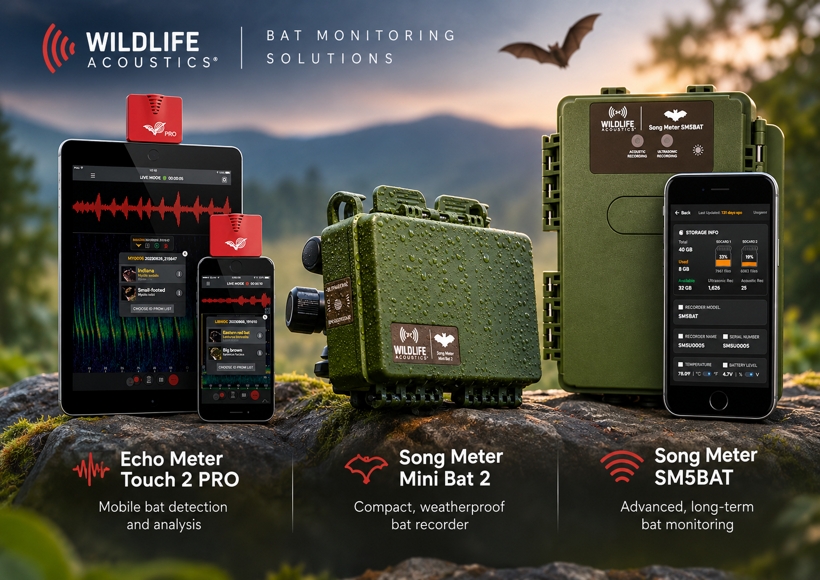
Wildlife Acoustics produces several devices designed for detecting, recording, and analyzing ultrasonic bat signals. These include the Echo Meter Touch 2 PRO, Song Meter Mini Bat 2, and Song Meter SM5BAT.
Despite sharing a common purpose, these models are designed for different use cases: one operates in conjunction with a smartphone, another is intended for standalone recording in the field, and the third is a professional multi-channel monitoring system.
1. Echo Meter Touch 2 PRO — bat detector for smartphones

A compact device that connects directly to a smartphone or tablet and turns it into an active bat detector.
The device was developed by Wildlife Acoustics primarily for researchers, conservationists, and environmental consultants.
Together with the free Echo Meter Touch app, the device allows you to detect, listen to, record, and analyze ultrasonic signals.
Key features:
– Detection and recording of ultrasonic signals from bats.
– Real-time audio monitoring.
– Display of signals on a color spectrogram.
– Automatic predictions regarding the two most likely bat species.
– Saving recordings in WAV format.
– Display of the observation location and route on the map.
– Transferring records to other users.
Three modes are provided for listening: Real-Time Expansion, Heterodyne, and Time Expansion.
One of the features of the PRO version is a low-noise microphone, three gain settings, and the option to select a sampling rate of 256 or 384 kHz. At the maximum setting, the device is capable of recording signals with frequencies up to 192 kHz.
Automatic species identification (Bat Auto-ID) is supported for several regions, including Europe.
Compatibility: modern versions of the device connect via USB-C . Operation requires a compatible iOS or Android smartphone or tablet. Apple devices with a Lightning connector are not supported.
Suitable for: bat enthusiasts, naturalists, ecologists, students, and professionals who wish to make observations directly while out walking or conducting research.
2. Song Meter Mini Bat 2 — autonomous ultrasonic recorder

Designed for the automatic recording of bat sounds in the natural environment.
Unlike the Echo Meter Touch 2 PRO, this is a standalone device that can be installed in the study area and left to operate according to a preset schedule.
The device is equipped with an ultrasonic microphone featuring a low self-noise level. A signal-triggered recording system helps capture bat sounds while reducing the number of unwanted recordings.
Key features:
– Automatic recording of ultrasonic signals.
– Configuring the work schedule.
– Recording triggered by sound detection or continuous recording.
– Saving audio materials for subsequent analysis.
– Removal of false positives using built-in processing tools.
– Configuration and control via the Song Meter Configurator app.
The housing has an IP67 protection rating. This allows the recorder to be used in the field, including in conditions involving exposure to dust and water.
The device is available in two power supply versions:
– AA: up to 50 nights of 10-hour recordings.
– Li-ion: up to 125 nights of 10-hour recordings.
To monitor not only bats but also birds, amphibians, and terrestrial mammals, an acoustic microphone module ( Acoustic Stub Microphone ) can be installed as an additional component.
Suitable for: nature researchers, ecologists, ornithologists, bat monitoring specialists, and enthusiasts who wish to study animals in a specific location over an extended period.
Song Meter SM5BAT — professional acoustic monitoring system

This is an autonomous system for long-term monitoring of natural sounds, capable of simultaneously recording ultrasonic bat signals and sounds within the human audible range.
The device is equipped with four independent recording channels:
– Two ultrasonic channels.
– Two acoustic channels.
This makes it possible to study bats, birds, and other animals simultaneously.
Key features:
– Simultaneous recording of ultrasonic and conventional acoustic signals.
– Recording in Full-spectrum WAV and Zero Crossing formats.
– Customizable monitoring schedule.
– Built-in ultrasonic and acoustic microphones.
– Built-in GPS/GLONASS .
– Time synchronization and geographic referencing of observations.
– Support for two SDHC/SDXC memory cards.
– Configuration via the built-in screen and buttons or a mobile app.
The SM5BAT supports multiple power options: 18650 lithium-ion batteries, D-cell alkaline batteries, and external power sources. It also allows for the connection of a solar power system.
According to the manufacturer's technical documentation, GPS/GLONASS is used for the automatic setting of time and coordinates, as well as for synchronizing multiple recorders during the spatial analysis of sounds.
Suitable for: professional ecologists, biologists, scientific organizations, universities, and research centers.
Conclusion
Wildlife Acoustics offers three different approaches to studying bats.
– The Echo Meter Touch 2 PRO turns your smartphone into a mobile detector, allowing you to observe bats while walking.
It is suitable for those who want to search for bats on their own, hear their ultrasonic signals, view spectrograms, and get clues about the species. It is particularly convenient for solo observation and walks.
– The Song Meter Mini Bat 2 autonomously records ultrasonic signals over multiple nights and is suitable for long-term monitoring.
It is suitable for those who need to automatically collect recordings at a specific location over multiple nights. It is a good choice for monitoring bats in forests, parks, and near bodies of water.
– The Song Meter SM5BAT is a professional research system that simultaneously records ultrasonic and audible ambient sounds.
It is suitable for professional researchers who need to simultaneously record ultrasonic and audible natural sounds. Four recording channels, GPS, and multiple power options make it ideal for complex monitoring projects.
The main difference lies not merely in price or technical specifications, but in the intended use of the devices: the Echo Meter is designed for direct observation, the Mini Bat for autonomous data collection, and the SM5BAT for comprehensive scientific research.
Source:
Wildlife Acoustics — Echo Meter Touch 2 PRO
Wildlife Acoustics — Song Meter Mini Bat 2
Wildlife Acoustics — Song Meter SM5BAT