

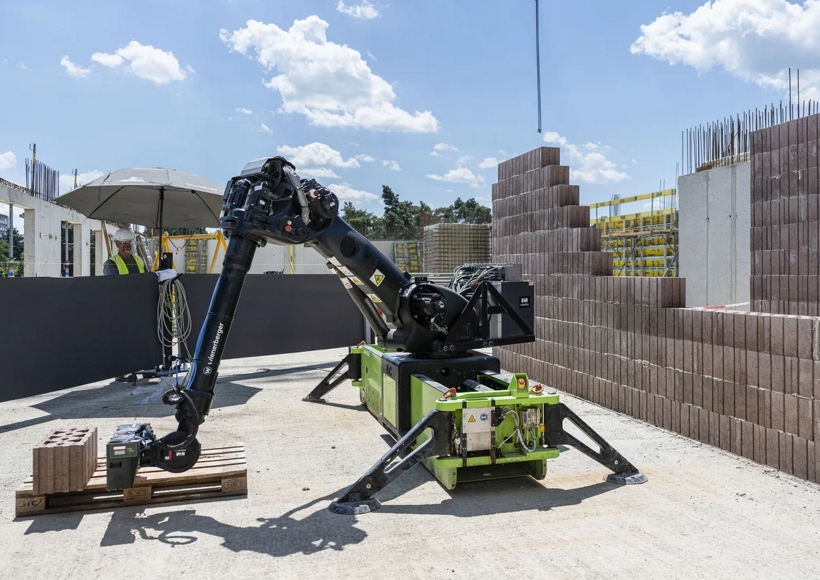
Walter (WLTR) is a robotic system for the automated laying of construction blocks that the Austrian construction company PORR is testing and using at an actual construction site in the Czech Republic.
Unlike traditional bricklaying, where a mason manually lifts and places each element, Walter performs the primary operation using a robotic mechanism. It receives data from the project's digital model, grips heavy blocks, and places them in the designated position.
A key feature of the system is its ability to handle large-format acoustic blocks weighing up to 52 kg. This enables the automation of one of the most physically demanding tasks on the construction site.
Important: Walter is not a proprietary development created by PORR from scratch. The robot belongs to the WLTR family, developed with the participation of Wienerberger, KM Robotics, and CIIRC CTU (Czech Technical University in Prague). PORR uses it at its construction sites.
1. Where is the Walter robot used?
One of the key examples of its application is the Kladno Living residential project, located in the city of Kladno near Prague, Czech Republic.
The project includes:
– five residential buildings;
– 371 apartments;
– underground and surface parking spaces;
– load-bearing walls;
– inter-apartment partitions made of acoustic ceramic blocks.
PORR began testing the robot on construction sites in 2025. In the Kladno Living project, it became part of the workflow from the very beginning of construction.
The goal of the trials is to assess the robot's suitability for a real-world construction site, how it interacts with workers, and how efficiently it performs masonry tasks.

2. Walter technical specifications
PORR has published the following specifications for the robot:
The Walter (WLTR) robot is a block-laying robot weighing 2,500 kg, featuring a 3.5 m working radius and an average productivity of 7.5 m²/h (up to a maximum of 10 m²/h). It is capable of laying blocks weighing up to 52 kg, operates based on a digital project model, requires two operators, and consumes 1.5 kW of power. According to PORR, the block placement precision is within the millimeter range.
Energy consumption is a particularly interesting metric. According to PORR, the robot consumes an average of 1.5 kW—a figure the company compares to the power output of a standard electric kettle.
3. How does the robot work?
The work is organized as follows:
1. Project preparation. The robot receives digital data regarding the location and dimensions of the future wall.
2. Construction site preparation. Specialists ensure the necessary space for maneuvering the machine and delivering materials.
3. Gripping the block. The manipulator lifts a construction element weighing up to 52 kg.
4. Positioning. The robot determines the position of the block relative to the design model.
5. Placement. The block is positioned at the designated location with millimeter precision, according to PORR.
6. Continuation of masonry work. The system sequentially performs the following operations.
The robot operates under the supervision of trained specialists. Two people are required to operate and maintain it: an operator and an assistant.
4. What kind of walls can Walter build?
At the Kladno Living project, a robot is used for laying large-format acoustic ceramic blocks.
According to PORR, the modern generation of such robots is already capable of handling not only long, straight wall sections but also corners and areas with window and door openings.
Main areas of application:
– load-bearing walls;
– inter-apartment partitions;
– walls made of large-format acoustic blocks;
– repetitive masonry sections in residential buildings.
Important: this is not a universal robot suitable for any brick or building block. The ability to handle a specific material depends on the gripper design, the dimensions of the elements, and the laying technique.
5. Productivity: is a robot faster than a human?
This is one of the most interesting questions.
PORR specifies Walter's average productivity at 7.5 m² of masonry per hour, with a maximum rate of up to 10 m²/h.
However, the company makes an important clarification: on the Kladno Living project, the robot's productivity proved comparable to that of an experienced bricklayer.
Thus, the main advantage of Walter lies not in a guaranteed manifold increase in laying speed, but in the automation of strenuous physical tasks:
– lifting heavy blocks;
– movement of construction elements;
– precise positioning of blocks;
– repetitive movements during laying.

6. Can Walter completely replace a mason?
No. PORR explicitly emphasizes that the human element remains an essential part of the construction process.
The system requires:
– robot operator;
– assistant for organizing material delivery;
– preparation of the construction base;
– verification of the correctness of the masonry;
– logistics planning;
– preparation of the construction site.
In addition, sufficient free space is required for the robot to operate.
PORR CEO Karl-Heinz Strauss emphasized that the goal of implementing the technology is not to replace workers, but to provide them with equipment that makes the most strenuous tasks easier.
7. Implementation date and prospects
Real-world application in 2026
– 2025 — PORR began testing the robot in real-world construction conditions.
– August 6, 2026 — The company published an official report on the use of Walter at the Kladno Living project in the Czech Republic.
– 2026 — plans are in place to apply the experience gained from using the robot to future projects of the PORR Group.
Conclusion
Walter (WLTR) is an interesting example of how digital technologies are gradually making their way directly onto the construction site.
The robot is capable of lifting blocks weighing up to 52 kg, positioning them according to a digital model, and laying them at an average rate of 7.5 m² per hour.
For the mason, this means reduced physical strain, while for the construction company, it offers the opportunity to automate repetitive tasks and maintain consistent masonry quality.
The key feature of Walter is not the complete replacement of humans, but rather collaboration between the robot and the construction crew.
Source: porr.at