

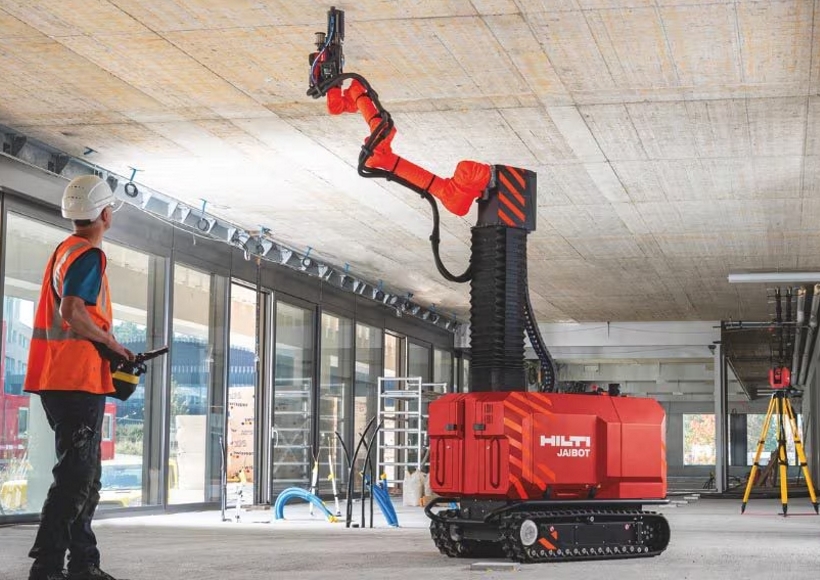
The Hilti Jaibot is a semi-autonomous construction robot designed to automatically drill holes, primarily in ceilings. Hilti unveiled the robot on October 28, 2020, describing it as the company’s first robot for the construction site. Its purpose is to take over a large volume of repetitive, physically demanding work typically performed by a construction worker using a rotary hammer overhead.
The Jaibot does not operate in isolation: before work begins, digital BIM data containing the coordinates of the planned holes is loaded into the system. An operator then moves the robot across the construction site using a remote control, while the Jaibot automatically positions itself and performs the drilling at the designated locations. A Hilti PLT 300 robotic total station system is used for positioning.
After drilling, the robot can apply markings indicating the type of engineering work for which the hole is intended. This is particularly useful during the installation of ventilation, air conditioning, heating, electrical, and other engineering systems—that is, in the MEP sector.
Interestingly, Jaibot does not simply replace a person with a rotary hammer. It links the digital construction model to the physical structure: BIM coordinates are translated directly into holes in the ceiling or wall. This reduces the need for manual layout work and eliminates the strain of constantly working with arms raised.
In 2022, Hilti expanded the robot’s capabilities. The Jaibot gained the ability to work with profiled metal ceiling structures, detect obstacles, and adjust its working area. Additionally, it became possible to automatically drill and mark holes in vertical concrete walls at heights ranging from 1.2 to 4.8 meters . The vacuum dust extraction system was also upgraded.

Hilti states that the Jaibot is capable of drilling over 1,000 holes per day and operating at ceiling heights of up to 5 meters. This is a manufacturer-rated performance figure that depends on specific site conditions.
Technical specifications
Type: semi-autonomous construction robot | Purpose: hole drilling and marking | Control: remote operator console | Data: BIM/digital plan | Positioning: Hilti PLT 300 | Productivity: over 1,000 holes/day* | Working height: up to 5 m* | Walls: 1.2–4.8 m | Dust removal: integrated vacuum system | Power supply: battery-powered, cordless.
* Based on Hilti data; actual performance depends on operating conditions.
Weight and battery
Hilti does not specify the weight of the Jaibot or the capacity of its battery pack in available official materials.
Is it used in Europe?
Yes. The Jaibot is being used on construction sites across Europe. Hilti cites, for example, a real-world project at a stadium in Karlsruhe, Germany, where the robot was used to drill a large number of holes for mounting acoustic elements. For this project, the Jaibot was provided along with data processing, training, and support.
EDGE Technologies Friedrichspark — Berlin, Germany
In 2025, the Hilti Jaibot was deployed at the major EDGE Technologies Friedrichspark construction site in Berlin. The construction company ZÜBLIN used the robot to drill holes in the ceilings of the future office complex. Hilti Deutschland published information about this project in 2025.
Construction site in Baumholder , Germany
In March 2025, news emerged of the first use of Jaibot by the OBG Group at a construction site in Baumholder, Rhineland-Palatinate.
In five days, the robot drilled approximately 4,000 holes. Following this, OBG announced plans to use Jaibot on the company’s other projects as well.
This is arguably one of the most illustrative examples for the article: it allows for demonstrating the robot’s actual performance at a real-world site.
RiS B — Freiburg, Germany
In June 2025, the Jaibot was used for the first time at the RiS B construction site in Freiburg. The robot was deployed by Karl Schies, the company responsible for the building’s technical systems.
A local newspaper in Freiburg reported that the robot was performing drilling work at a site where a new building costing around €100 million was under construction.
Eastwood Private Hospital — Australia
There is also a documented instance of Jaibot being used on the Eastwood Private Hospital project. Materials from the Innovation & Excellence Awards 2025 indicate that Hindmarsh Plumbing utilized Jaibot for ceiling installation work. According to the project description, the robot helped reduce manual labor and shorten project timelines.
Thus, the Hilti Jaibot is neither a concept nor an experimental prototype, but a digital construction technology already in practical use. Its key distinction from conventional construction tools is the link between BIM, the robot, and automated drilling.
Date of submission: October 28, 2020.
Manufacturer: Hilti.
Source: official Hilti Jaibot announcement